FAQs
Why were the Speed Humps removed?
The speed humps originally installed on this section of Glenmore Avenue were not accessible to wheelchair users and were removed after residents raised accessibility concerns with BCDOT and the Councilman’s office. In the long term, a project led by BCDOT’s ADA team will be necessary to reconstruct the sidewalks to meet accessibility standards.
Why aren't Speed Humps replacing the chicane along the entire corridor?
The Harford Road Gateway was the only segment within the study area to experience crashes attributed to the chicane design during the study period. BCDOT observed successful speed mitigation along the rest of the corridor due to chicane implementation.
What is the data collection method?
Data was collected using both automated and manual methods. Automated data collection involved the use of a Speed Sentry Shield system, operated without the dynamic speed display to avoid influencing driver behavior. Manual data collection was conducted on-site by personnel wearing safety vests and from unmarked vehicles to discreetly observe traffic patterns. BCDOT takes steps to minimize observation bias in all street studies. Operators make efforts to remain as unobtrusive as possible during data collection to ensure more accurate results. Additionally, using multiple data collection methods helps further reduce bias and improve the reliability of the findings.
Is the speed sentry the same as a portable speed camera? Assuming so, isn’t it likely that drivers slowed down because they could see it?
The tools used to observe speed in this study is different from a typical speed camera. To prevent observation bias, BCDOT uses minimally invasive equipment while monitoring traffic behavior. The device used in this study is a Speed Sentry – Shield. This looks like a 2-foot by 2-foot black box strapped to a pole. The speed display on the Shield is disabled to minimize its presence to drivers.
What is the Harford Rd Gateway segment?
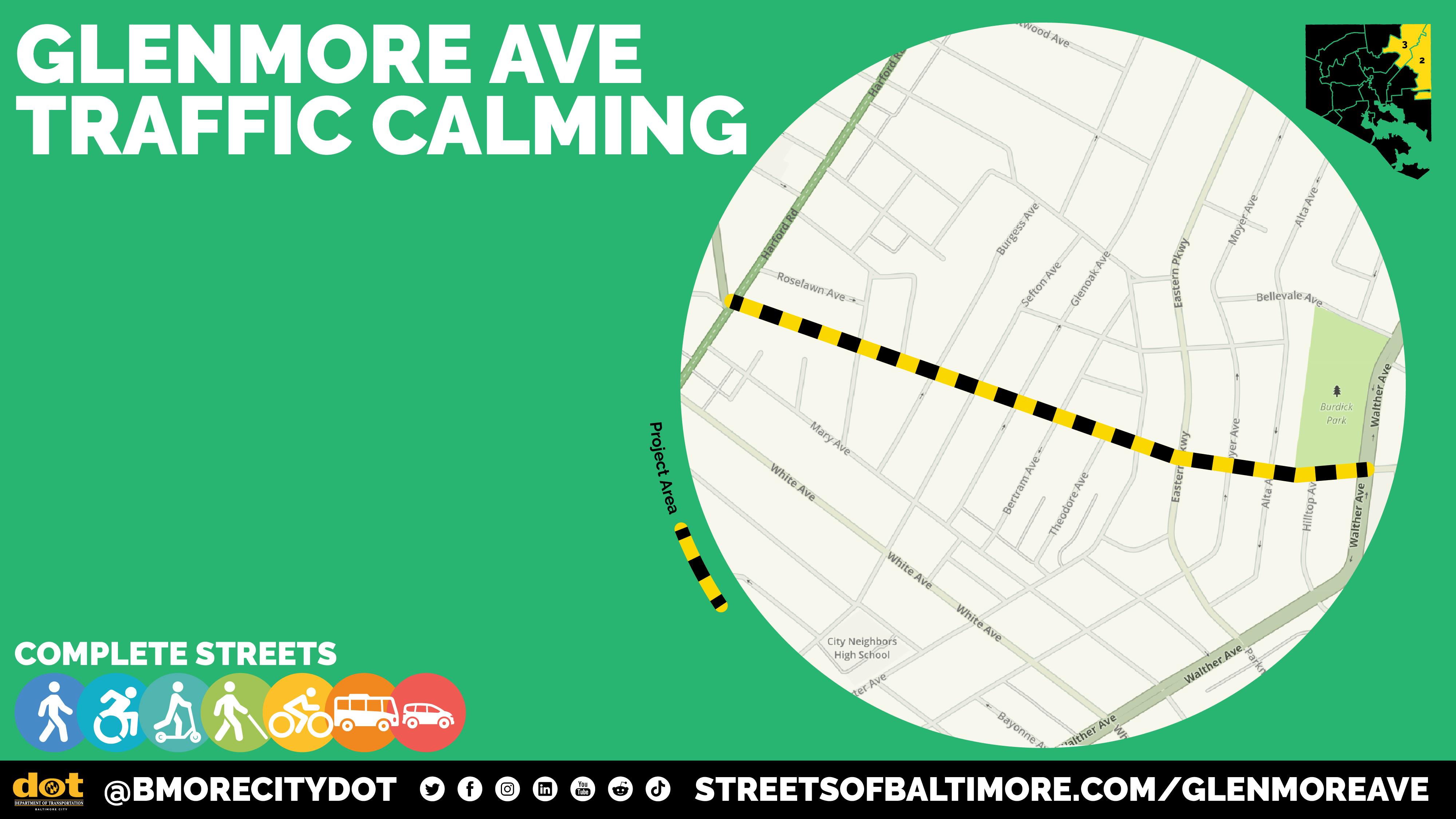
The Harford Road Gateway refers to the first block of Glenmore Avenue off Harford Road (the 3000 block). This segment has 9-foot travel lanes, making it the narrowest portion of the corridor. It is distinct from the rest of the study area due to its limited roadway width and close proximity to the major arterial route of Harford Road. Given the higher number of crashes and significant community feedback, BCDOT engineers focused particular attention on this section when developing recommendations.
What are the next steps?
The next steps involve removing two existing traffic shifts on the 3000 and 3100 blocks of Glenmore Avenue and installing three speed humps to help reduce vehicle speeds. These speed humps will be placed within the travel lane, leaving the parking lane to clearly maintain accessibility for wheelchair users and cyclists. Additionally, an all-way stop will be installed at Burgess Avenue to further calm traffic and support consistent, safe travel speeds through the area.
Why was my parking modified
Parking was modified to make room for the chicane features, which were installed to support ADA accessibility along the corridor. The sidewalks in the area do not meet ADA standards, forcing some users to travel in the street. Speed humps, even with emergency and bicycle bypass cuts, were not suitable for ADA users to navigate through.
We understand that the chicanes have affected the parking configuration and availability. Significant effort went into designing them to minimize this impact. We are looking into medium-term options to address parking concerns. In the long term, we think the best course of action is to install ADA-compliant sidewalks, which may allow for the return of the previous street configuration with added speed humps for traffic calming.
Explain the 60 vehicle violation recorded in a single day and what changed as the study progressed?
While the number is accounted for in our records, it includes minor infractions on the double yellow which occurred due to the narrowness of the road along the 3000 block. After reviewing this case, we standardized the definition of a violation to only include vehicles that deliberately crossed the double yellow line and made no effort to keep in the lane. This definition focuses on driver behavior rather than extraneous issues that don't change with the design.
Assuming the flex posts are essential to the design and driver compliance, will DOT replace flex posts as they get knocked down/damaged?
DOT will replace flex posts as they are damaged; however, we ask that residents submit a 311 request to alert our maintenance crews when repairs are needed.