FAQs
What materials are being used and why?
This project will use a variety of materials to make a safe and separated path for users of all ages and abilities to enjoy. The main materials will be concrete precast curbs, known as “pills", and flex post.
The pills will provide curb like protection at a lower cost and with expedited installation speed compared to poured concrete.
The flex post will be used as vertical delineation to help drivers identify the lane and provide reflectivity at night. flex post will also assist snowplows in spotting the facility during winter storms.
While requested, materials like jersey barriers or larger pieces concrete separation, as found on BIG Jump, are good for specific projects. Material selection requires project context and must consider factors like material availability, its impacts on safety, time to install, cost, and importantly its impact on the greater community. In the future, BCDOT is moving towards a standard application of concrete curbs plus flexpost as our standard materials for bike/micromobility projects.
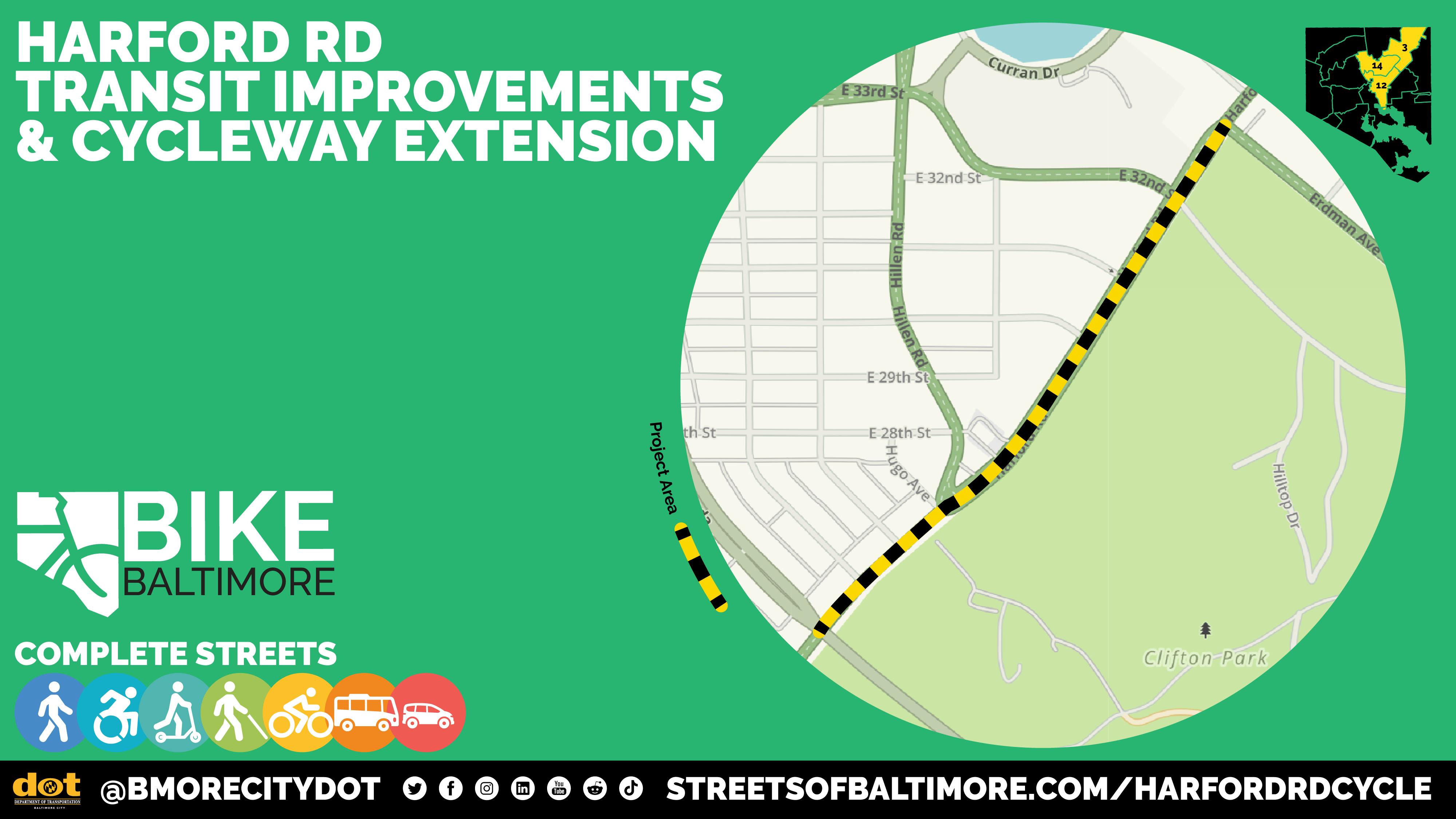
Can we extend to 25th street?
Expansion beyond St.Lo is not planned as part of this project and would conflict with both the CSX bridge replacement and the REACH! stadium construction. Both of these projects will impact traffic near the intersection of Harford and 25th St. The CSX bridge replacement is projected to finish in 2027. Given the number of inquiries, BCDOT will evaluate the feasibility of future expansions as a later phase or as a separate project after the bridge's completion.
What kind of safety benefits do projects like these provide?
BCDOT conducted a comprehensive analysis which compares crash data in the general area from 2015 - 2024 to evaluate the effectiveness of safety improvements installed for the Complete Streets ordinance. Overall traffic corridors with Complete Steets treatments (bump-outs, additional striping, flexpost, concrete pills, etc.) exhibit an increase in safety compared to streets without treatments.
Looking specifically at existing improvements on Harford Road, both vehicular and pedestrian safety have improved. For instance, crashes involving pedestrians decreased by 50% more when compared to city wide statistics.
The proposed improvements align with the INSPIRE plan to provide equitable connections for the local communities to adjacent amenities and resources. These increases in pedestrian safety will be helpful in fulfilling the goals of INSPIRE as well.
What kind of impact do projects like these have and how do engineers determine travel lane need?
BCDOT utilizes a variety of design guides from local, state, and federal sources to determine the lane configurations along with analyzing factors like crash data, average speed, and travel impacts. In this project, BCDOT partnered with a traffic consulting firm to conduct traffic studies to evaluate travel demand through the corridor and analyze how many dedicated lanes that demand requires based on current industry standards.
BCDOT is also currently collecting speed and count data so that a before and after comparisons to traffic patterns can be made.