Share Counter Program on FacebookShare Counter Program on X (formerly Twitter)Share Counter Program on LinkedinEmail Counter Program link
We collect and analyze city pedestrian and bicycle facility usage data to support practical bike and pedestrian planning.
This data informs the public and decision-makers about usage patterns, analyzes trends, and evaluates the impacts of specific projects through mobile counts.
A robust bike count program tracks data to demonstrate how strategic investments in infrastructure increase ridership, create safer streets, and provide greater access to opportunities.
Capturing a wide range of trips and riders and highlighting critical insights from the data helps us plan for and advocate for more equitable biking environments.
What do the counters count?
Most of the counters we have count bicyclists, but some of the newer counters also count scooter riders and pedestrians.
How many counters are there?
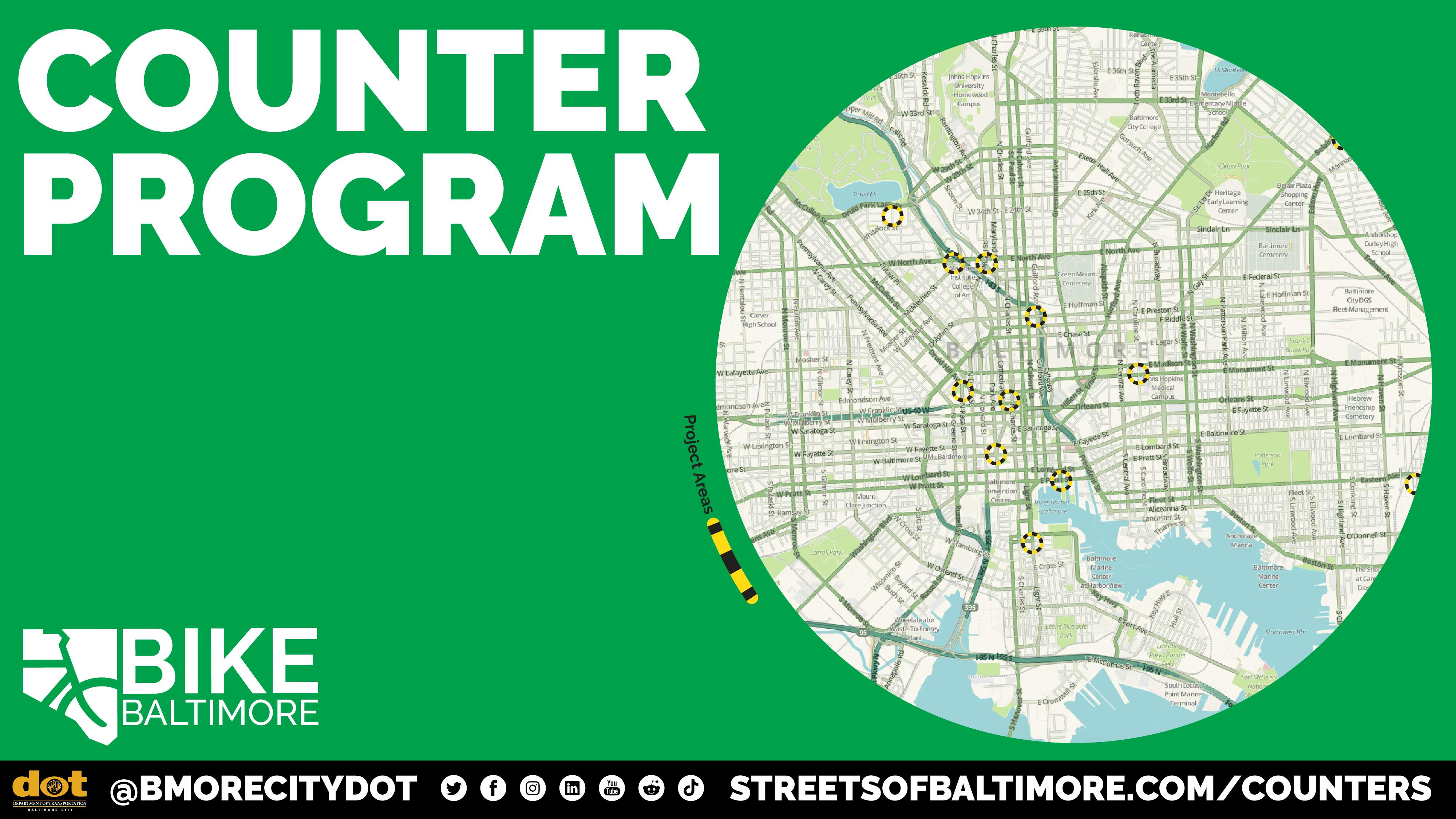
Currently, 14 count stations are installed on roadways and trails across Baltimore City.
Ten counters were installed in 2023, and four more were installed in 2024 on trails throughout the City.
These counters are designed to track the movement of pedestrians and cyclists across sidewalks and shared spaces. Using infrared technology, they detect people as they pass, giving us accurate data on the number of users in different parts of the city.
Uses: Counts pedestrians and cyclists
Location: Installed on sidewalks and shared paths
Technology: Infrared detection for reliable and discreet counting
Bicycle-Only Counters
Bicycle-only counters detect bicycles on dedicated bike lanes and mixed-use roads using inductive loops. These counters help us monitor the number of cyclists using our streets, providing valuable insight into the effectiveness of bike infrastructure.
Uses: Counts bicycles only
Location: Mixed traffic roads, dedicated bike lanes
Technology: Inductive loop system for precise bicycle detection
Multi-User Counters
In greenways and natural areas, multi-user counters track pedestrians, cyclists, and scooters. These counters are designed to capture data in natural spaces without disturbing the landscape, providing a more comprehensive look at how people use our trails and paths.
Uses: Counts pedestrians, cyclists, and scooters
Location: Greenways and natural trails
Technology: Combination of infrared and inductive loops for multi-user tracking
We collect and analyze city pedestrian and bicycle facility usage data to support practical bike and pedestrian planning.
This data informs the public and decision-makers about usage patterns, analyzes trends, and evaluates the impacts of specific projects through mobile counts.
A robust bike count program tracks data to demonstrate how strategic investments in infrastructure increase ridership, create safer streets, and provide greater access to opportunities.
Capturing a wide range of trips and riders and highlighting critical insights from the data helps us plan for and advocate for more equitable biking environments.
What do the counters count?
Most of the counters we have count bicyclists, but some of the newer counters also count scooter riders and pedestrians.
How many counters are there?
Currently, 14 count stations are installed on roadways and trails across Baltimore City.
Ten counters were installed in 2023, and four more were installed in 2024 on trails throughout the City.
These counters are designed to track the movement of pedestrians and cyclists across sidewalks and shared spaces. Using infrared technology, they detect people as they pass, giving us accurate data on the number of users in different parts of the city.
Uses: Counts pedestrians and cyclists
Location: Installed on sidewalks and shared paths
Technology: Infrared detection for reliable and discreet counting
Bicycle-Only Counters
Bicycle-only counters detect bicycles on dedicated bike lanes and mixed-use roads using inductive loops. These counters help us monitor the number of cyclists using our streets, providing valuable insight into the effectiveness of bike infrastructure.
Uses: Counts bicycles only
Location: Mixed traffic roads, dedicated bike lanes
Technology: Inductive loop system for precise bicycle detection
Multi-User Counters
In greenways and natural areas, multi-user counters track pedestrians, cyclists, and scooters. These counters are designed to capture data in natural spaces without disturbing the landscape, providing a more comprehensive look at how people use our trails and paths.
Uses: Counts pedestrians, cyclists, and scooters
Location: Greenways and natural trails
Technology: Combination of infrared and inductive loops for multi-user tracking
Share If I am reading your data presented here correctly, the numbers do not reflect eyewitness observations after many passings through these sites. Observers note little to no users contrary to the numbers you present here from about two years running.
Cameras posted in these locations (running 24/7) might present more compelling and convincing evidence of usage. on FacebookShare If I am reading your data presented here correctly, the numbers do not reflect eyewitness observations after many passings through these sites. Observers note little to no users contrary to the numbers you present here from about two years running.
Cameras posted in these locations (running 24/7) might present more compelling and convincing evidence of usage. on X (formerly Twitter)Share If I am reading your data presented here correctly, the numbers do not reflect eyewitness observations after many passings through these sites. Observers note little to no users contrary to the numbers you present here from about two years running.
Cameras posted in these locations (running 24/7) might present more compelling and convincing evidence of usage. on LinkedinEmail If I am reading your data presented here correctly, the numbers do not reflect eyewitness observations after many passings through these sites. Observers note little to no users contrary to the numbers you present here from about two years running.
Cameras posted in these locations (running 24/7) might present more compelling and convincing evidence of usage. link
If I am reading your data presented here correctly, the numbers do not reflect eyewitness observations after many passings through these sites. Observers note little to no users contrary to the numbers you present here from about two years running.
Cameras posted in these locations (running 24/7) might present more compelling and convincing evidence of usage.
Scott
asked
3 months ago
Thanks for your comment! We run the Counter Program along side Eco Counter, they are a company that helps us track and store our data. By keeping these counters in working condition and active, with yearly battery swaps, we are sure that the data presented is fully correct. We also have a data cleaning service where they will triple check any anomalies that we receive. There are ways we can install camera based counters, which have AI software to use to even more so correctly count data. Those will be included in our next Phase of this project.


Thank you for your contribution!
Help us reach out to more people in the community
Share this with family and friends