Restoring Connections to Druid Hill Park
About
Restoring Connections to Druid Hill Park will create a safer, multi-modal Druid Park Lake Drive corridor that is safe and accessible for people of all ages and abilities. The Project builds on a Complete Streets Feasibility study completed in 2022, which developed concept-level designs. In March of 2024, BCDOT received $6 million in Neighborhood Access and Equity (NAE) funds from the U.S. Department of Transportation (USDOT) to complete preliminary engineering, environmental documentation, and public outreach to select a locally preferred alternative (LPA) and reach 30% design.
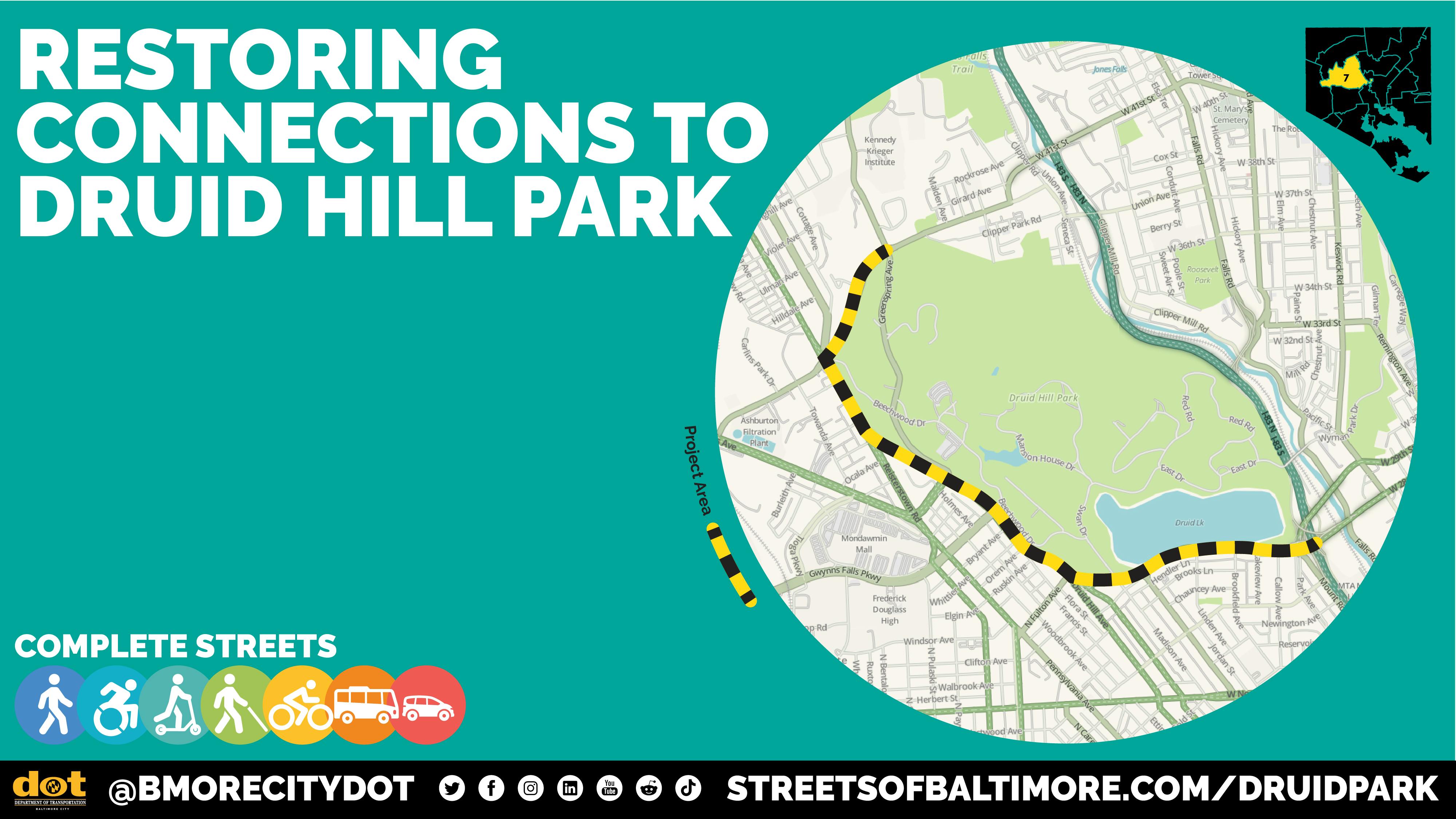
 Project Location Map
Background
Druid Park Lake Drive is a 2.3-mile corridor in West Baltimore that runs along the perimeter of Druid Hill Park from I-83 to Greenspring Ave. Originally a two-lane residential street, the current alignment of Druid Park Lake Drive is now a 4-to-9-lane arterial road that carries high-speed vehicle traffic, lacks safe pedestrian, bicycle and transit infrastructure, and effectively creates a barrier between neighboring communities and Druid Hill Park.
 Existing conditions on the corridor include up to nine travel lanes, complex intersections, and a lack of safe pedestrian and bicycle infrastructure.In 2022, BCDOT initiated a Complete Streets Feasibility study for Druid Park Lake Drive in response to grassroots advocacy calling for safer conditions for pedestrians, cyclists, and transit users on the corridor. Through this study, the City conducted analyses of the corridor, coordinated with internal and external stakeholders, and used Complete Streets and NACTO design guidance to develop three end-to-end concepts for Druid Park Lake Drive that improve the safety, accessibility, multi-modal infrastructure, and overall aesthetics of the corridor. The result is three concept designs that provide safe and accessible connections for people traveling on foot, wheelchair, bicycle, transit, e-scooters, and cars.
Addressing Equity
The Corridor is a 2.3-mile principal arterial roadway in Baltimore City with up to nine travel lanes that divides several high-poverty, majority Black communities from Druid Hill Park, one of Baltimore’s largest and most visited parks. The Project is located fully within underserved and disadvantaged communities in Baltimore and will generate significant benefits for residents who have historically been harmed by discriminatory transportation and housing policies, advancing the City’s goals for racial equity.
Long-Term Vision
In March 2024, the U.S. Department of Transportation (USDOT) awarded BCDOT $6 million in Neighborhood Access and Equity (NAE) grant funding to advance engineering for the Druid Park Lake Drive Corridor from concept design to 30% design. The project will also focus on conducting public outreach and performing environmental documentation to support NEPA.
Developing Complete Streets Concepts for Druid Park Lake Drive
The concepts developed through the Druid Park Lake Drive Complete Streets Feasibility Study were developed using Complete Streets guidance as detailed in Baltimore City’s Complete Streets Manual (2021) and guidance from resources such as the National Association of City Transportation Officials (NACTO) design guides. Through a public outreach process, review of existing plans and studies, discussions with Baltimore City agencies, and application of Complete Streets design principles and best practices, the Project Team developed three concepts for a reimagined Druid Park Lake Drive.
Guiding Complete Streets principles
- Address safety first;
- Be accessible by everyone;
- Improve mobility;
- Ensure equity;
- Reflect Baltimore’s unique communities; and
- Be sustainable.
 One of three conceptual design options proposed in the Druid Park Lake Drive Complete Streets Feasibility Study (2022). Public Outreach
An extensive public outreach process was conducted to gain input from community members surrounding the project areas. Public outreach activities included:
- Conducting one-on-one interviews with community leaders;
- Organizing community stakeholder visioning exercises;
- Creating virtual field tours using ArcGIS Online ;
- Presenting at meetings with community groups; and
- Holding public meetings and pop-up events.

Thank you for your contribution!
Help us reach out to more people in the community
Share this with family and friends